Nothing is technically broken. The customer still leaves.
That’s why e-commerce localization matters. Online shoppers don’t experience your store as a set of translated words, but as a sequence of small trust decisions.
Can I find the right product? Do I understand the price, delivery time, return policy, and local payment methods? Does the checkout feel familiar?
If any part of that path feels foreign, potential customers don’t pause to admire your global ambition. They buy somewhere else.
E-commerce localization is a language task, but even more importantly, it’s the work of making the full shopping experience feel clear, credible, and usable in a specific target market.
E-Commerce Localization Is Purchase-Path Localization
Many companies still treat localization as a content layer. First they build the store, then they translate the visible text, then they hope the new market performs.
That’s a fragile way to expand.
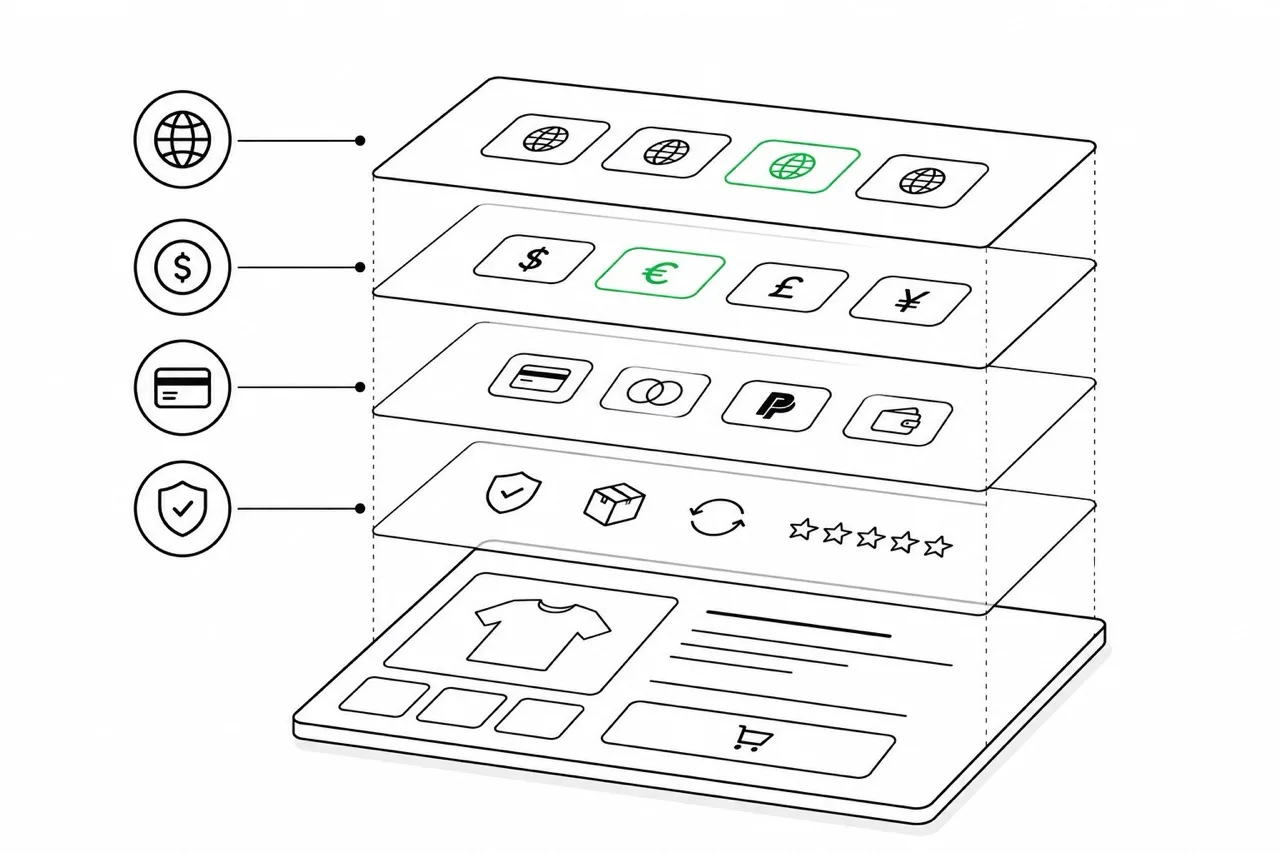
A buying journey has several stages: discovery, product evaluation, price comparison, checkout, delivery, returns, and customer support. Localization has to cover the whole path. A perfectly translated homepage won’t help much if the product descriptions are unclear, the currency is wrong, the local payment option is missing, or the return policy fuels doubt.
Translation changes the language. Localization adapts the buying environment.
For an ecommerce shop, that includes:
- product names and descriptions
- category labels and filters
- size guides and measurement units
- local currency and tax display
- delivery promises and returns wording
- payment method options
- checkout copy and error messages
- customer support articles and email templates
- SEO pages for local search
- trust signals, reviews, and guarantees
In other words, a localized online store does not merely tell people what you sell. It helps them decide whether buying from you feels normal.
Product Descriptions Should Remove Local Doubt
Good descriptions are where e-commerce localization earns its keep.
A weak localization workflow treats product descriptions as text blocks to translate. A stronger workflow asks what buyers in each market need to know before they feel confident enough to buy.
That may mean adapting size information, material descriptions, care instructions, safety claims, compatibility details, warranty language, or sustainability wording. It may also mean reworking the order of information. A detail that feels secondary in one market can be a deciding factor in another.
For example, a furniture store entering the German market may need to localize their descriptions around dimensions, material composition, delivery logistics, assembly requirements, and return conditions. German buyers will usually expect practical clarity. Vague lifestyle copy may resonate less than precise information.
A beauty brand entering France may need a different approach to product claims, ingredient names, tone, and compliance-sensitive wording as part of their localization efforts. A translated claim that sounds acceptable in English could sound exaggerated, odd, or even legally risky in another locale.
AI can help draft and scale descriptions, especially when the product catalogue is large. But AI needs instructions, terminology, examples, and review to produce high-quality localized content. If you simply run thousands of SKUs through machine translation, you’re apt to get fluent copy that still fails to answer the buyer’s real questions.
A localized product description should reduce hesitation, not add another small reason to abandon the page.
The Money Layer Has to Feel Native… and Seamless
The closer a customer gets to payment, the less patience they have for friction.
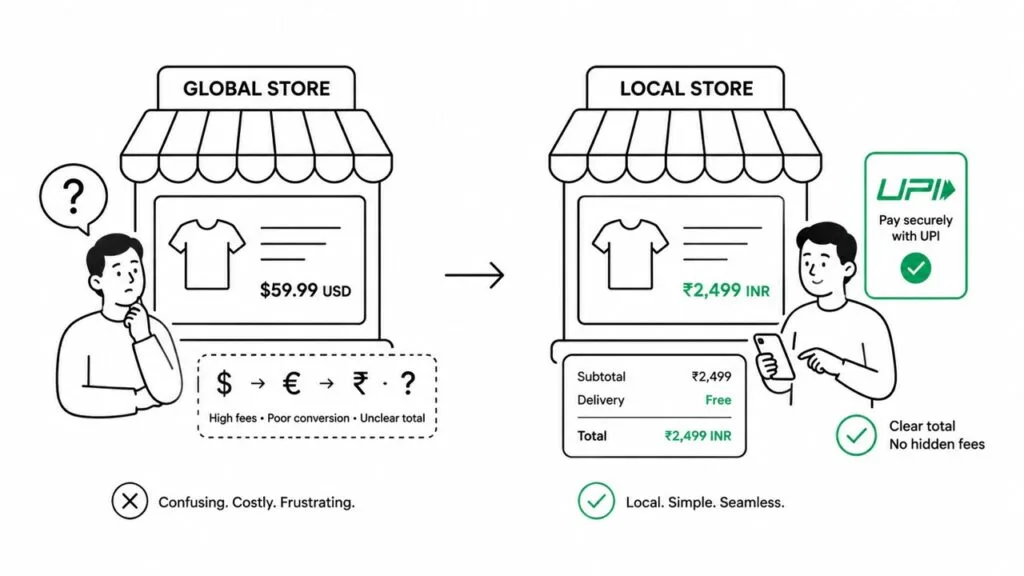
Currency is the obvious part. If shoppers have to convert prices themselves, you’re asking them to do extra mental work at the exact moment they’re deciding whether to buy. Even when a customer can technically pay, the experience will still feel foreign.
The payment method matters just as much. Credit card-first checkout might feel normal in one market and incomplete in another. In some countries, invoice payment, bank transfer, digital wallets, or local payment systems can strongly influence trust and conversion rates.
The same applies to tax, shipping, and returns. Customers want to know:
- Is the price final?
- Is VAT or sales tax included?
- How much is shipping?
- When will the order arrive?
- Who pays return shipping?
- How long do refunds take?
- Is customer support available in my local language?
These questions are not decorative. They sit directly between interest and purchase.
Good localization makes the money layer feel familiar. It adapts currency, local payment options, tax wording, delivery promises, return language, and checkout flows to the expectations of the target market.
Poor localization leaves shoppers wondering whether the store is serious about serving them.
Local Search Is Not Just Translated SEO
E-commerce localization also affects how customers find you!
Translated SEO is often too literal. It takes the source-market keyword and tries to translate it into another language. Search rarely works that neatly. People describe products differently across different markets. They use other modifiers, category terms, problem statements, and comparison phrases.
A keyword that works in English may not match local search engines in German, French, Spanish, or Dutch. Even when the literal translation is correct, it might not be the phrase your target audience actually uses.
For ecommerce localization, SEO should feed into the store structure, not sit in a blog silo. Local search research can shape:
- category names
- product titles
- product descriptions
- filters
- comparison pages
- buying guides
- FAQs
- internal links
- campaign landing pages
This is especially important for Shopify and other ecommerce platforms where product feeds, collections, metadata, and landing pages often drive organic visibility.
A multilingual store is not automatically discoverable. You need localized SEO that reflects how people search in the local market, not how your source-language team describes the product.
Where AI Helps E-Commerce Sites, and Where It Can Quietly Cost Sales
AI has changed the economics of localization. Used well, it can help an e-commerce business localize more content, faster, and at a lower cost than fully manual workflows.
That matters because ecommerce content volume can be brutal. Descriptions, category pages, support articles, campaign banners, email flows, reviews, metadata, and marketplace feeds all change constantly.
AI can help with:
- first-draft translation
- terminology extraction
- product description variants
- SEO keyword clustering
- support content drafts
- translation memory leverage
- content classification by risk
- quality checks against style rules
- identifying pages where localization may improve conversion rates
But AI isn’t a market strategy. It can translate text, suggest variants and help with scale. But it cannot fully decide whether your checkout feels trustworthy in the target market, whether a product claim sounds credible, or whether your return policy is going to cause friction.
Raw machine translation is especially risky near the buying decision. Payment process copy, product claims, refund language, legal text, sizing information, and high-value product pages need human review. A professional translator or localization specialist can catch issues that a fluent AI output may hide.
So the best model isn’t “AI instead of localization”. It’s AI inside a controlled localization workflow. It gives you speed for sure, but it’s human judgment that protects your brand’s trust.
Workflow Problem: Your Online Store Keeps Changing
A static website can be localized once and maintained occasionally. An online shop cannot.
New products launch. Old products disappear. Prices change. Seasonal campaigns go live. Item descriptions get rewritten. Shipping thresholds move. Return policies change. Customer support learns new pain points. SEO pages need updates. Analytics reveal where users drop off.
And this is exactly where many ecommerce localization projects quietly fail.
The first launch might look great. Six months later though, the source market has new content, better product pages, clearer support articles, and updated campaigns, but the content for the localized markets is looking stale.
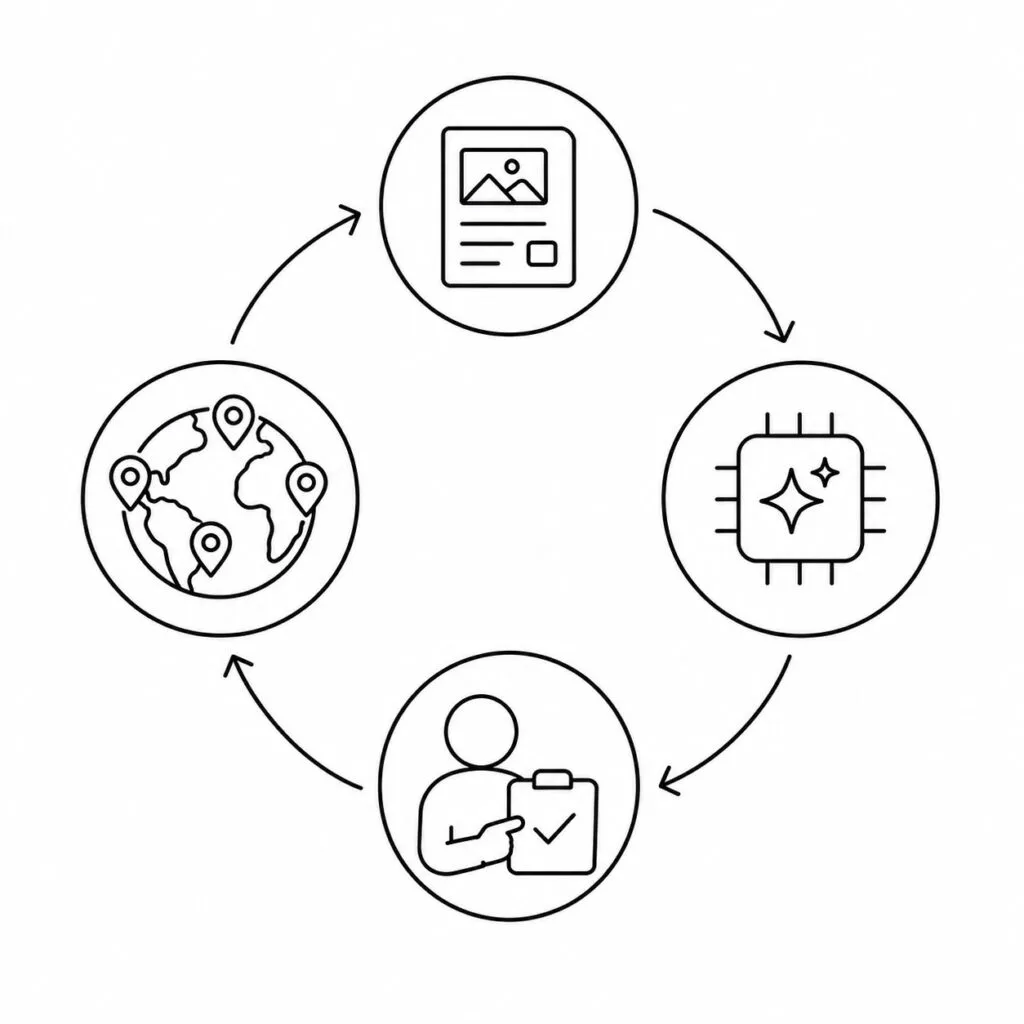
To avoid that drift, localization needs strategic processes.
A serious ecommerce localization workflow usually includes:
- a translation management system
- translation memory
- terminology rules
- AI translation settings
- human review for high-risk content
- clear ownership between marketing, product, support, and legal
- analytics to decide what to localize first
- a process for new and updated product content
- quality checks before content goes live
A localization tool can help, but the tool is not the workflow. The workflow is the system of decisions around what gets localized, who reviews it, how often it updates, and how quality is measured.
Without that system, teams end up copying text into spreadsheets, losing context, duplicating work, and wondering why every new market feels as hard as the last.
What to Localize First If Budget Is Limited for Multiple Markets
Most teams can’t localize everything at once. The good news is that they don’t need to.
The smarter approach is to start where localization is most likely to affect revenue, trust, or support volume.
If budget is limited, prioritize:
- Top-selling products. Start with the products most likely to sell in the new market. Localize article descriptions, metadata, size guides, FAQs, and images where needed.
- High-intent category pages. These matter for both SEO and conversion. They help customers understand what you sell and help search engines understand what the page should rank for.
- Checkout and payment. Localize copy, payment method labels, error messages, shipping information, tax wording, and confirmation emails. This is where ambiguity becomes expensive!
- Delivery and returns. Clear return and delivery information can build trust quickly. Confusing policies create hesitation, especially for international customers buying from a store they’re unfamiliar with.
- Customer support content. Localize support articles, order-status messages, refund templates, and common email replies. Customer support in the native language can reduce friction both before and after purchase.
- Paid landing pages. If you’re paying for traffic in a local market, the landing page shouldn’t feel like an afterthought. Localize the offer, proof points, product examples, and call to action.
- High-risk or high-margin products. Products with technical details, safety claims, sizing complexity, or higher return risk deserve extra review. AI can help draft them, but they shouldn’t ship without a human once-over.
This approach keeps localization tied to business value. You’re not localizing everything just because the content exists. Instead, you’re localizing the parts of the online store that most influence whether people buy, return, complain, or come back.
Ecommerce Localization Is a Growth Catalyst
Whether you call it eComm localization, store localization, or simply making the buying path fit the market, the point is the same: customers judge the whole experience, not just the words on the page.
If you want to sell globally, your store has to feel local in the moments that matter.
A customer doesn’t give a hoot whether your internal localization process is elegant; they only care about a seamless user experience. Whether they can understand the product, trust the price, use a familiar payment method, receive clear delivery information, and get help if something goes wrong.
That’s why e-commerce localization belongs in the growth conversation, not just the translation budget. It affects customer experience, SEO, checkout completion, support load, and conversion rates. It helps you adapt your online store so as to expand into new markets in a way that feels commercially serious.
Businesses winning abroad don’t just translate more content. They localize the buying path and customer journey.
Make Your Store Feel Buyable in the Next Market
If your online store is getting international traffic but not enough international customers, the issue may not be demand. It may be friction.
Expand Your Reach with Expert Language Solutions
Partner with Modilingua for tailored content localization strategy, international SEO, and bespoke translation services. Break cultural barriers and grow your business in new markets with scalable, user-centric solutions.
Modilingua reviews the full buying path, from local search and product descriptions to currency, checkout, payment, customer support, and AI-assisted localization workflow, so you know what to fix first. Get in touch!
