
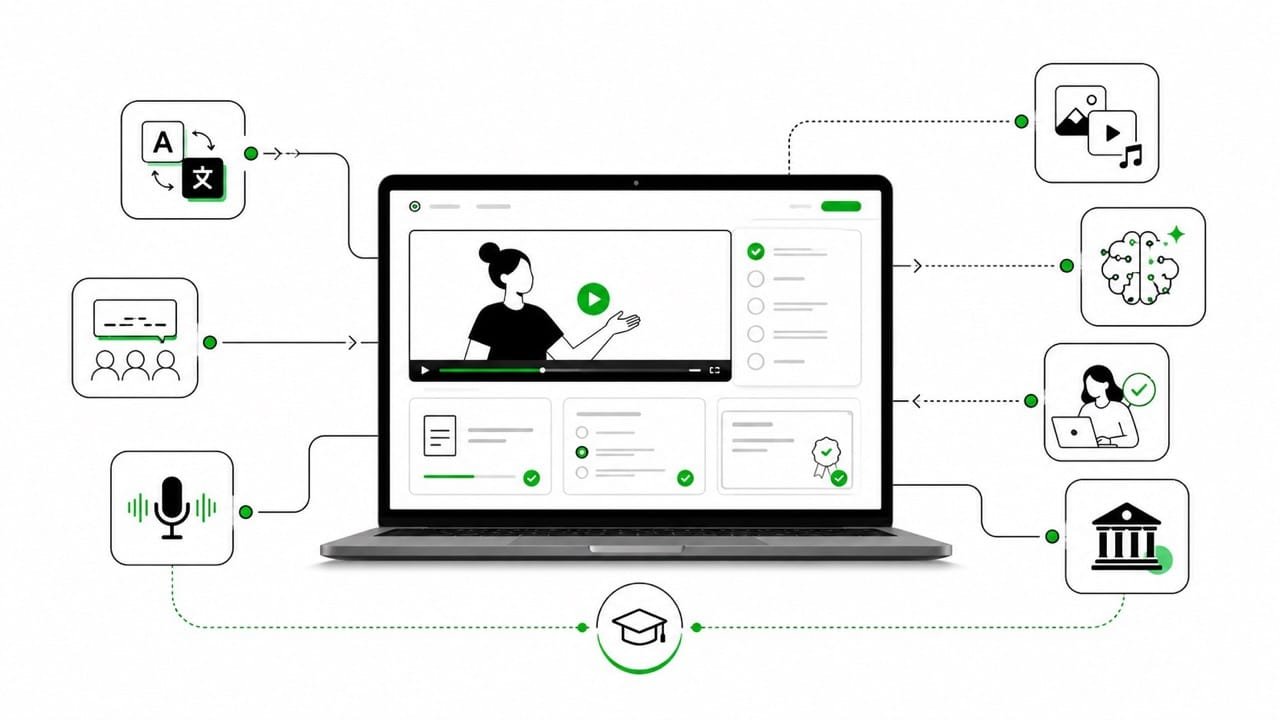
Even if the translation is accurate, screenshots may show the wrong interface language, voice-over may no longer match the visuals, quizzes can become misaligned and examples that make perfect sense in one country can fall flat in another.
That’s why professional e-learning localization services involve more than translation. They adapt every part of an eLearning course, from multimedia and subtitles to technical formats and cultural references, so learners in every target language receive an equally high-quality training experience.
If you’re training global staff, educating customers or delivering compliance training, localization will help make sure your learning content is clear, culturally relevant and technically reliable across multiple languages.
What Do eLearning Localization Services Entail?
At first glance, eLearning localization may look like little more than eLearning translation services. In reality though, translation is just one stage of a broader localization process.
A typical eLearning localization project begins by reviewing the source course before any translation starts. Content that relies on culture-specific references, idioms, screenshots or regulatory information is identified early on so it can be adapted rather than translated literally. Terminology is mapped and aligned in advance to keep key concepts consistent throughout every module. Eventually, translation memories will help maintain that consistency as courses expand into additional languages.
In such, the goal here isn’t simply to produce translated content, but to create a localized learning experience that feels as though it were originally developed for each learner in their native language.
If you’re unfamiliar with the distinction, my guide to translation vs. localization explains why adapting language and culture produces better results than word-for-word translation alone.
Localizing More Than Just Text
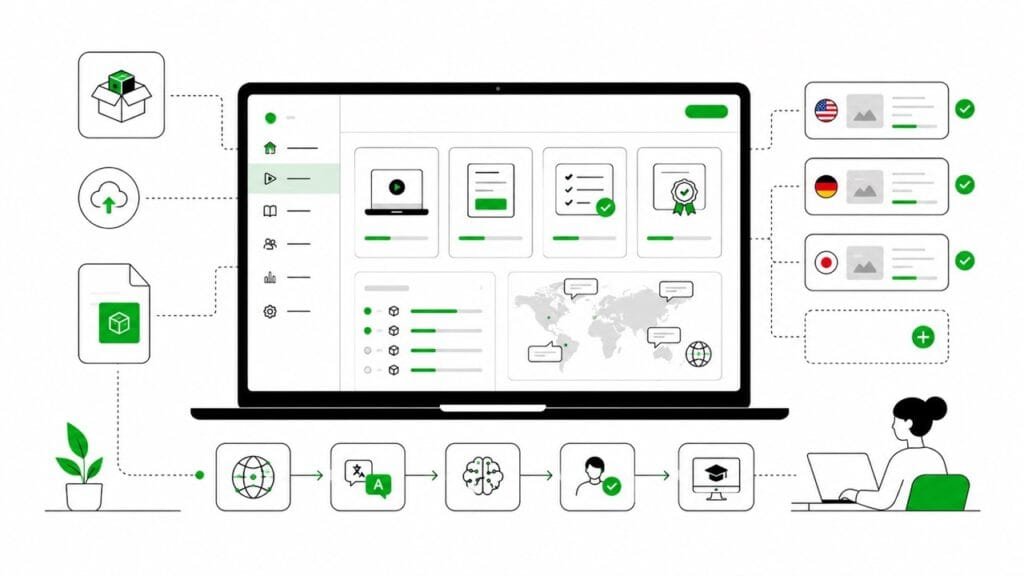
If you’ve worked through any sort of online course yourself in the last ten years, you know that modern eLearning content usually contains a lot more than paragraphs on a screen. Professional eLearning localization services typically cover graphics, subtitles, and possibly even voice-over narration, downloadable training materials, assessments and multimedia alongside the written content itself.
Course content created in authoring tools like Adobe Captivate or Articulate Storyline also requires technical attention. Interactive elements, branching scenarios and animations need to continue working correctly after localization, while SCORM or Experience API packages have to remain compatible with the target learning management system (LMS).
Accessibility should also be considered throughout the localization process. Localized subtitles, captions and alternative text help make training available to more learners while supporting organizations which need to meet accessibility or regulatory requirements.
Similar principles apply when localizing software, documentation and customer-facing platforms. My article on software internationalization explores those challenges in more detail.
The eLearning Localization Process
Localization should follow a structured workflow rather than treating translation as the final step before going live.
After reviewing the source material, linguists prepare terminology and reference material before translating the course into each target language. AI and machine translation can often accelerate the first draft (especially for large training programs), but instructional content still benefits from human review so that terminology stays accurate and explanations resonate with learners.
Once the linguistic work is complete, all of the multimedia elements like subtitles, voice-over recordings and graphics are localized to go alongside the course itself. The localized modules are then usually tested inside the LMS to verify navigation, any quizzes, interactive exercises and multimedia all function correctly. Functional testing at this stage helps identify layout issues, broken links or formatting problems before learners access the course.
A structured localization workflow like this makes future updates much easier. When translation memories, terminology and review processes are already in place, new modules and revised training materials can be published more quickly without having to sacrifice quality.
If you’re using artificial intelligence as part of your language strategy, my post about AI localization explains where automation works well, and where human expertise still adds the most value.
Business Benefits, Learner Engagement, and Global Market Access
Organizations invest in eLearning localization because effective training depends on comprehension, not simply language translation.
Learners are more likely to complete courses when terminology is uniform, examples feel familiar and multimedia has been adapted for their language and culture. For international businesses, localized eLearning also helps create a smoother onboarding experience, and better product education and compliance training across regions. All while reducing the cost of maintaining separate learning programs for every market.
The best eLearning localization services combine translation, cultural adaptation, multimedia localization, technical testing and quality assurance into a repeatable process that scales as an organization grows internationally.
Many of the same principles also apply to multilingual customer support, where consistent terminology, structured workflows and human review help deliver a better experience across every language.
